In the competitive US landscape, a business proposal is often the only thing standing between a visionary idea and a signed contract. Whether you are a startup founder pitching to a VC in Silicon Valley or a contractor bidding on a federal project in D.C., the document you produce serves as a surrogate for your brand’s competence.
However, the “yes” isn’t found in fancy fonts or corporate jargon; it is found in the alignment of your solution with the client’s pain points. According to recent industry data, high-performing sales teams are 2.3x more likely to prioritize value-based selling over feature-based selling. This shift underscores a vital truth: a winning proposal isn’t a brochure; it’s a strategic roadmap.
The Psychology of the “Yes”
Before putting pen to paper, you must understand that every stakeholder is looking for three things: Risk Mitigation, ROI, and Reliability. In the high-stakes world of corporate procurement, decision-makers are often more afraid of making a “wrong” choice than they are excited about a “good” one.
For many professionals and students entering the business world, the technicalities of these documents can be overwhelming. This is where professional business proposal writing services become a strategic asset. By utilizing experts who understand market-specific nuances, you ensure that your tone, structure, and data points meet the rigorous standards expected by American executives.
1. The Pre-Writing Phase: Research and Empathy
You cannot solve a problem you don’t understand. Top-tier writers spend 60% of their time on research and only 40% on drafting.
- The Client’s “Why”: Why are they seeking help now?
- The Competitor Landscape: Who else are they talking to?
- The Budgetary Guardrails: Is this a lean operation or a premium overhaul?
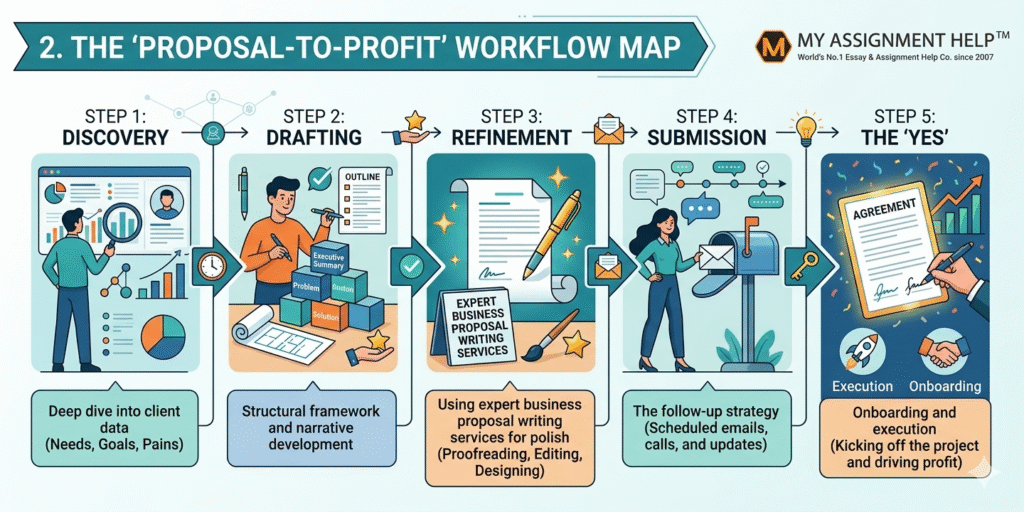
2. Structural Integrity: The Winning Framework
A proposal should follow a logical flow that mirrors a conversation.
A. The Executive Summary This is the most important page. It should focus entirely on the results, not your company history. If the reader only has two minutes, they should know exactly how much they will gain and how much it will cost.
B. Problem Statement (The “Pain” Point) Mirror the client’s language back to them. This builds instant rapport and shows you have been listening.
C. The Proposed Solution Detail your methodology. Use data-driven milestones rather than vague promises. For those managing multiple projects or academic business cases, a reliable assignment writing service can help in gathering the necessary secondary research and case studies to bolster this section.
D. Pricing and Terms Transparency is key. Avoid “hidden fees.” Provide tiered options (e.g., Basic, Pro, Elite) to give the client a sense of control over the investment.
3. Data-Driven Authority (E-E-A-T)
To satisfy Google’s E-E-A-T (Experience, Expertise, Authoritativeness, and Trustworthiness) standards and—more importantly—your client’s scrutiny, you must back your claims with evidence.
- Social Proof: Include case studies with 18%–25% efficiency gains or specific revenue increases.
- Visual Data: Don’t just say “we grow businesses.” Show a “Skill-to-Salary” bridge or a “Projected ROI” graph.
- External References: Cite sources like the Harvard Business Review or Statista to validate your market claims.
4. Avoiding the “Spammy” Look in Google’s Eyes
Internal and external linking should always be editorial, not promotional. When we interlink to professional services, we do so to provide the reader with a “next step” solution to the problem currently being discussed. Search engines value links that reduce user friction and provide comprehensive answers to a query.
Key Takeaways
- Focus on Outcomes: Sell the “hole,” not the “drill.”
- Customization is Mandatory: Never use a generic template for a high-value client.
- Visuals Matter: Use infographics to break up dense financial data.
- Proofread for Precision: Typos in a proposal suggest a lack of attention to detail in your work.
See also: How Big Data Is Changing Business Decisions
Frequently Asked Questions (FAQ)
Q: How long should a business proposal be?
A: It depends on the project scope. A small freelance gig might require 3–5 pages, while a multi-million dollar government contract could exceed 50 pages. Focus on clarity over length.
Q: Should I include my company’s history?
A: Only if it directly proves you have the expertise to solve the current problem. Keep the “About Us” section brief and move it toward the end.
Q: What is the most common reason proposals are rejected?
A: Failure to address the client’s specific needs. Many companies send “templated” proposals that talk more about themselves than the client.
Q: Is it okay to use professional writing help?
A: Yes. Many successful businesses use consultants and professional services to ensure their documentation is polished, persuasive, and legally sound.
About the Author
James Sterling is a Senior Content Strategist at MyAssignmentHelp. With over a decade of experience in business communication and SEO, James specializes in helping students and young professionals bridge the gap between academic theory and real-world business execution. His work focuses on data-backed narratives and the implementation of E-E-A-T principles in digital marketing.
Sources and References
- Harvard Business Review: “The Art of the Pitch.”
- Statista: “Business Consulting Market Trends in the US 2025-2026.”
- Google Search Central: “E-E-A-T and Quality Rater Guidelines.”
- Small Business Administration (SBA): “Writing a Winning Business Proposal Guide.